Most litigators have mediated cases and typically there is posturing and the “dance” that takes place before serious negotiations begin. These are time consuming and ultimately can result in a very long, exhausting mediation session. There is another more structured mediation method that offers fast and less costly resolution of disputes. Whether or not it gains widespread use remains to be seen.
In 2022 the American Bar Association began looking at Early Dispute Resolution (“EDR”) as one of the tools for helping courts, attorneys and parties deal with overcrowded dockets.1 In 2024 the ABA House of Delegates formally adopted a resolution urging attorneys and parties to use EDR.2 Recently, the American Arbitration Association introduced a panel specializing in EDR mediation. Training is offered through the non-profit EDR Institute.3
EDR is a structured mediation process designed for resolving disputes pre-litigation or just after litigation has commenced. If litigation has commenced, the parties can use it before the parties have incurred significant expenses in discovery and motion practice. It is centered around EDR Guidelines (f/k/a Protocols). They include a four step process that provides the mediator, attorneys and parties the opportunity to simplify the dispute from many overlapping claims and counterclaims down to the core dispute(s), exchange key documents for case evaluation, engage in risk evaluation and negotiate a mutually acceptable settlement over a span of several weeks. In many cases a backstop in-person mediation is scheduled at the outset for use in the event the matter is not resolved or terminated through the telephone/videoconferencing negotiations. The mediator is much more involved in the pre-mediation sessions than he or she is in a traditional mediation.
EDR takes place before litigation discovery so it requires good faith participation by the parties and attorneys from the outset and it is not unusual for them to sign a good faith certification that may be incorporated into a subsequent agreement. If an opposing party later finds that exculpatory or other key documents were hidden or withheld, that party may be able to resort to a court for remedy. Obviously, this requires a different mindset for litigators who are accustomed to wanting all the information, documents and depositions before engaging in substantial settlement negotiations. The value to the client is EDR can substantially reduce the cost of resolving the dispute in terms of time and money. The value to the attorney is the file is closed earlier and he or she has the appreciation of the client for conserving resources of time and money. That may be a possible reputation enhancement available to counsel. Confidentiality remains a core part of EDR just like traditional mediation.
The first step in the EDR process is case evaluation. Typically, the mediator will hold a telephone/videoconference call with all the attorneys and parties jointly to explain the process, encourage good faith participation, go over necessary disclosures and discuss any other matters or questions that may arise. During this initial call, the mediator and attorneys/parties will try to simplify the dispute down to the core issues. Of course, the mediator will want to know each side’s view of the dispute and whether there have been any prior efforts at settlement. If the mediator requests position statements, he or she may request that they be shared between the parties and supplemented to the mediator with any confidential material the attorneys/parties want to share with the mediator only.
Step two of the mediation is sharing of key documents between the sides. The mediator will request a short list of key documents needed by each side for case evaluation. Again, litigators will have trouble with this because the mediator is going to encourage the list to be tight and pointed only to the key issues for the purpose of case evaluation. This is not discovery, it is evaluation. After the lists have been independently finalized with the mediator, the parties will exchange the documents with copies to the mediator according to a pre-established schedule. In extreme but necessary circumstances, the parties and mediator may agree that witness statements can be taken (on or off the record) and experts employed. If an expert is required, the mediator will suggest that the parties agree on a joint expert to opine on the issue and share the cost. The format for the witness interviews will be agreed to by the parties and often the mediator will ask pre-arranged questions with input from the attorneys.
The EDR can be suspended at any time if a party determines that it needs resolution by a judge or arbitrator of a central legal issue such as a statute of limitations defense. It is hoped that this will be the exception because it will slow down the EDR process and add to the costs to the parties.
Once the information exchange is complete, the process moves to the third stage of risk analysis of each side’s case. This stage is primarily in confidential caucus with the mediator and involves a concept of risk analysis that is not in wide use among litigators and will require a learning curve. The mediator will work with each side independently to develop a decision tree that produces a risk adjusted value of the dispute. This takes into account incurred costs, projected costs if the case goes to trial (and, perhaps, appeal), other forward looking costs, and the litigator’s best judgment of success on the claim(s) and/or counterclaim(s). The litigator should also consider extraneous facts such as the history of the judge or jury of the locale in similar cases and a weighted estimate of the high, low and midpoint recovery (or loss in the case of a defendant without counterclaims). In the end, the decision tree will produce a probability based risk adjusted value (RAV) of the case. The RAV is not meant to be the absolute value of the case, it is a reality check on expectations and is useful in formulating a negotiating strategy for resolution of the dispute without further litigation. The decision tree is not fixed in stone. Inputs can always be adjusted as new information is gathered or opinions change but it can be very useful in evaluating a dispute so long as good, honest information is fed into the model. The attorneys and parties must be careful to input information that is grounded on truth, experience and best judgment for the decision tree to be of value. The RAV can also be a useful way for the litigator to reality check his or her client’s unjustified expectations. Each side keeps its own decision tree which is shared only with the mediator.
Additionally, each side may wish to develop a decision tree of its best idea of its opponent’s decision tree to further inform its negotiation strategy. Of course, that tree will be a “best guess” because it will not be based on the information in possession of the opponent. The mediator will have the true decision trees of each side in confidence and will use them to help steer negotiations to a fair settlement that is hopefully reflected by overlaps in the respective decision trees.
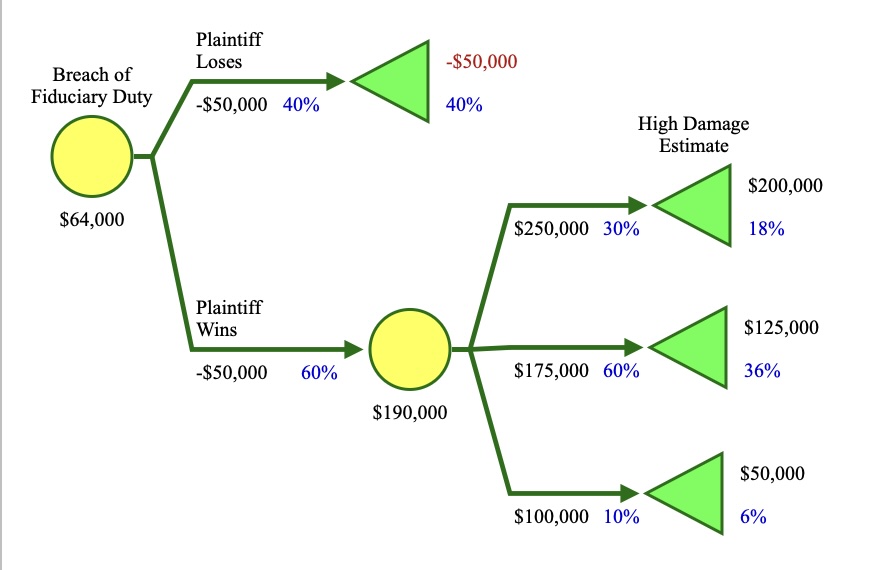
Once the RAV has been established, the parties move into the fourth and final stage of negotiations. There is nothing unique about the negotiations other than the fact that the parties are armed with their respective RAV (and possibly their estimate of the opponent’s RAV). By this point the mediator should have a good idea if the case can settle and it may be that the mediator terminates the mediation without stated reason because he or she has determined that proceeding will be a waste of time, effort and money. If negotiations continue, there is a good chance the dispute will be resolved before the parties have expended a huge amount of time and money. If the case still does not settle after the negotiations, it moves to the pre-scheduled in-person mediation session. If the dispute does not settle at mediation the parties have still gained information and perspective about their own and their opponent’s case. Litigation discovery can be more tailored to the case and not the all encompassing discovery requests commonly employed. Furthermore, the parties will have a much more informed view of the relative merits of each claim and/or counterclaim.
Most litigators are not accustomed to evaluating their cases using decision trees. The hardcore proponents of EDR claim it can be used in any case, but each litigator and his or her client will have to decide if it is appropriate for their dispute. Like mediation in general, it is totally voluntary so it will not be employed unless all sides to the dispute, including the mediator, agree. The reality is there is a learning curve to EDR so many litigators may not have the time or inclination to employ it. But, EDR can benefit the clients with a tangible result of much lower litigation costs and time and effort expended. And, like regular mediation, it is confidential so reputations may be preserved and perhaps family relationships can be restored.
- 1. See e.g., Tim G. Warner, Crisis in the Courts Paves the Way for Early Dispute Resolution, Just Resolutions Newsletter, American Bar Association, August 31, 2022.
- 2. Felicia Harris Hoss and Ellie K. Vilendrer, “ABA Unanimously Adopts Policy Encouraging Early Dispute Resolution,” Just Resolutions Newsletter, American Bar Association, May 29, 2024.
- 3. https://www.edrinstitute.org/
- 4. A free open source widely used decision tree application is available at https://silverdecisions.pl/.
 EASTERN SHORE MEDIATION
P.O. BOX 1473 · FAIRHOPE, ALABAMA 36533 · (205) 531-1116 · JIM@EASTERNSHOREMEDIATION.COM
EASTERN SHORE MEDIATION
P.O. BOX 1473 · FAIRHOPE, ALABAMA 36533 · (205) 531-1116 · JIM@EASTERNSHOREMEDIATION.COM